

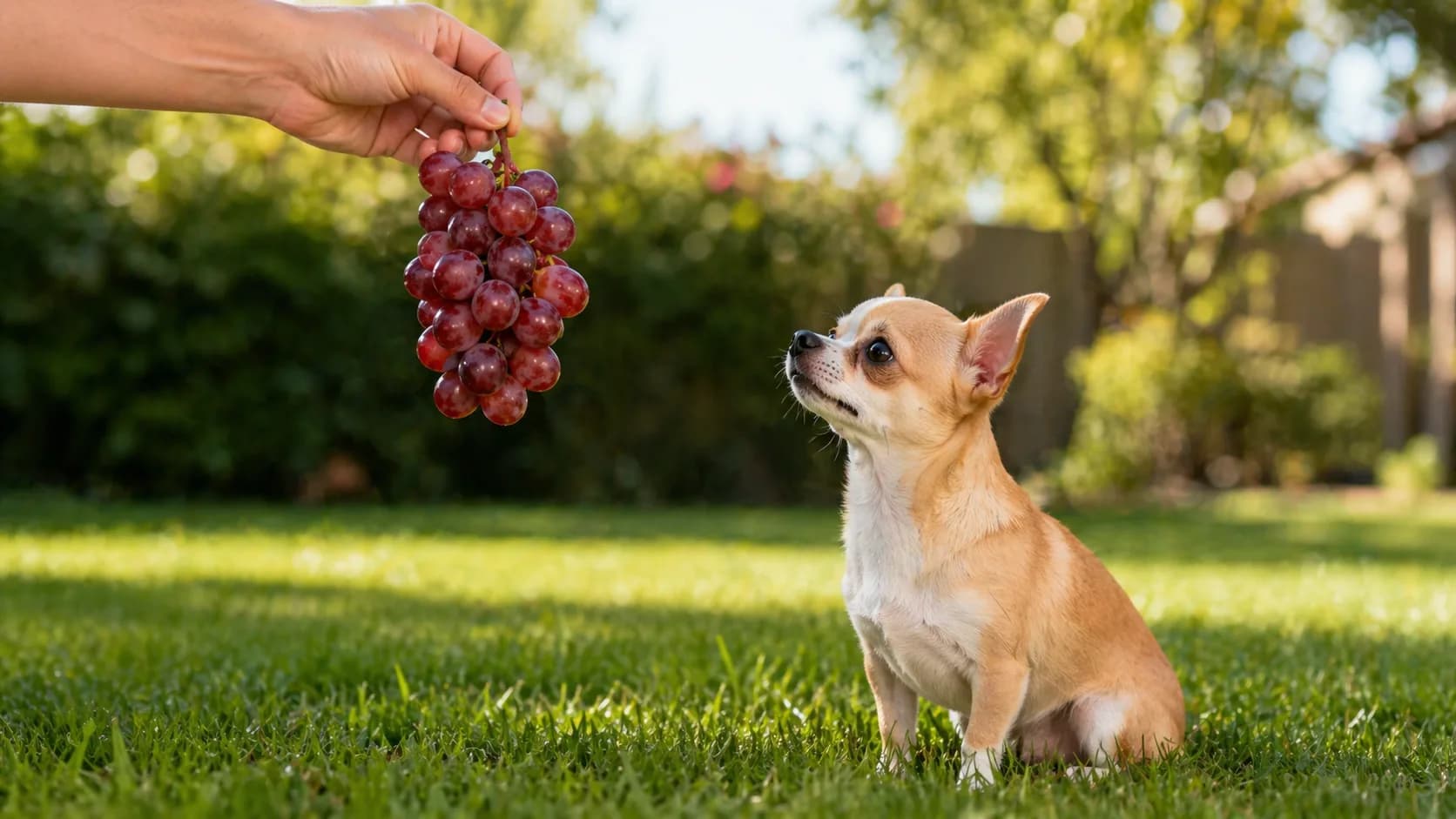
Can dogs eat grapes?
No. Grapes are toxic to dogs and should never be fed intentionally or left within reach.
Unlike some foods where the risk scales with amount, grapes do not work that way. Some dogs have become seriously ill after eating just a few. Others have eaten more without obvious immediate effects. There is no reliable threshold, no safe variety, and no way to predict how an individual dog will respond. That unpredictability is exactly what makes grapes dangerous.
The same rule applies to every form — fresh, frozen, dried, or cooked. Raisins, currants, and sultanas are dried grapes and carry the same toxicity, often at even smaller amounts because the compounds concentrate during drying.
Why can't dogs eat grapes?
The honest answer is that veterinary science has not fully identified the toxic compound responsible.
Several theories have been investigated over the years — tartaric acid is currently the leading candidate — but no single mechanism has been definitively confirmed. What is well established is the outcome: grape and raisin ingestion can cause acute kidney injury in dogs, sometimes progressing to kidney failure.
Why some dogs seem to tolerate exposure while others suffer severe consequences from a small amount is not understood. That variability is not a reason for optimism. It is a reason to treat every exposure as potentially serious.
Can dogs eat green grapes, red grapes, seedless grapes, or cotton candy grapes?
None of them are safe.
Green grapes, red grapes, seedless grapes, and cotton candy grapes are all toxic to dogs. The variety does not change the risk. Seedless grapes are not safer because they lack seeds — the toxicity has nothing to do with the seeds. Cotton candy grapes are a cultivated variety of table grape, not a different fruit, and carry the same concern as any other grape.
No grape variety has been identified as safe for dogs.
Can dogs eat grapes or raisins?
Neither. Raisins are dried grapes, and the drying process concentrates whatever compounds cause toxicity — which means raisins are considered even more dangerous than fresh grapes by weight. Smaller amounts of raisins have been associated with serious outcomes in dogs.
Currants and sultanas fall into the same category. Any product containing these ingredients — trail mix, baked goods, cereals, snack bars — should be kept away from dogs entirely.
How many grapes can a dog eat?
None. There is no established safe amount of grapes or raisins for dogs.
Toxicity cases have been reported after very small quantities. The dose that causes harm appears to vary between individual dogs in ways that cannot be predicted in advance. Waiting to find out where a particular dog falls on that spectrum is not a reasonable approach.
Can one grape hurt a dog?
Yes. One grape can be concerning because serious reactions have been reported after small exposures.
This is not something to brush off as “just one grape.” Because the toxic amount is unpredictable, even a small exposure deserves a vet call.
Can dogs die from eating grapes?
Yes. Grape and raisin toxicity can progress to acute kidney failure, which can be fatal without prompt treatment.
Dogs that receive veterinary care quickly — before kidney damage progresses — have better outcomes. Dogs that are not treated, or where treatment is delayed, face a significantly worse prognosis. The speed of intervention matters more than almost any other factor in grape toxicity cases.
Can dogs eat frozen grapes?
No. Freezing does not neutralize the toxic compounds in grapes.
Frozen grapes are sometimes given to dogs as a cool treat, which makes this worth stating clearly: frozen grapes are just as dangerous as fresh ones. The temperature change does not alter the toxicity in any way.
Can dogs eat grape jelly, grape juice, or grape-flavored foods?
Grape jelly and grape juice contain real grape derivatives and should not be given to dogs. Grape jelly also typically contains high amounts of sugar, and some products use xylitol as a sweetener — a separate toxin that causes rapid, severe hypoglycemia in dogs.
Grape-flavored foods — candies, drinks, snacks — are a different matter. Most grape-flavored products use artificial flavoring rather than real grape, which means the specific toxicity concern is less clear. They are still not appropriate treats for dogs, but the risk profile differs from actual grape or raisin exposure. When in doubt about an ingredient list, call a vet.
Can dogs eat grape leaves?
Grape leaves are not confirmed safe for dogs. They have not been studied with the same depth as the fruit, and the absence of documented toxicity cases is not the same as established safety.
Cooked grape leaves used in Mediterranean cuisine often contain garlic, onion, salt, oil, or other seasonings that carry their own risks. Plain or prepared, grape leaves are not something to offer a dog.
Symptoms of grape poisoning in dogs
Symptoms can develop within a few hours of ingestion. Early signs are often gastrointestinal — vomiting, diarrhea, loss of appetite, lethargy, and abdominal discomfort. As kidney involvement progresses, signs may include decreased or absent urination, weakness, tremors, and collapse.
Watch for:
- Vomiting, sometimes within hours of eating grapes
- Diarrhea
- Lethargy or sudden weakness
- Loss of appetite
- Abdominal pain
- Decreased urination or no urination
- Increased thirst followed by reduced urination
- Tremors or difficulty walking
- Collapse
The absence of immediate vomiting does not mean the dog is unaffected. Kidney damage can develop over 24 to 72 hours. Do not wait for severe symptoms before acting.
What should you do if your dog ate grapes?
Call a vet or emergency animal clinic immediately — do not wait to see whether symptoms develop.
Early treatment dramatically improves outcomes in grape toxicity cases. A vet may induce vomiting if the ingestion was recent and the dog is not already symptomatic, then recommend monitoring, supportive care, or hospitalization depending on the situation. The window for the most effective intervention is narrow.
Do not induce vomiting at home without veterinary instruction.
Dog ate grapes? Read what to do next →
Safe fruits for dogs instead of grapes
Several fruits are well-tolerated by dogs and carry none of the risks grapes do:
- Blueberries: Low in calories, easy to serve, no preparation required
- Watermelon: Hydrating and well-tolerated — remove the rind and seeds
- Apple slices: Crunchy and low in fat — remove the core and seeds entirely
- Strawberries: Naturally sweet and safe in small amounts
- Banana: Soft and easy to serve, higher in sugar than most options
- Mango: Safe in small amounts with the pit and skin removed
Introduce any new food slowly and keep portions modest. None of these carry the unpredictable toxicity risk that grapes do — which is the only reason grapes need a replacement in the first place.