

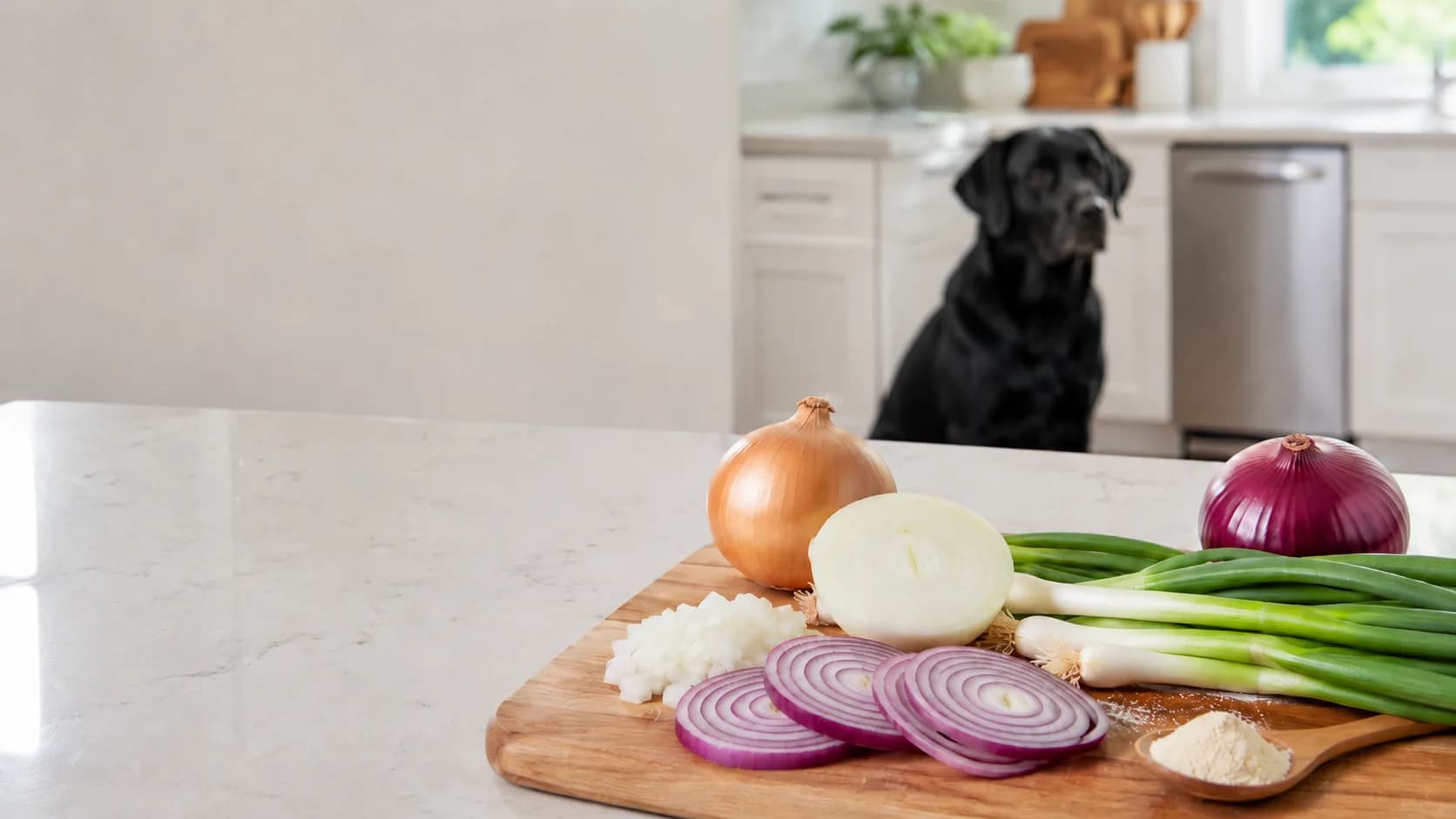
Can Dogs Eat Onions?
No, and this one does not have a "small amounts are usually fine" caveat attached to it.
Onions belong to the Allium family alongside garlic, chives, leeks, shallots, and green onions — a group that shares the same core toxicity mechanism for dogs. The danger does not disappear with cooking, blending, or seasoning. Sautéed onions in a pan sauce, powdered onion in a spice blend, and raw onion on a burger are all the same problem in different packaging.
The practical implication: if a dish was made with onion, it is not safe to share with a dog — not even the parts that don't visibly contain onion pieces.
Why Can't Dogs Eat Onions?
Onions contain compounds — primarily organosulfides — that oxidize and damage canine red blood cells. When enough red blood cells are destroyed, the result is hemolytic anemia: the body can no longer deliver adequate oxygen to tissues.
What makes onion exposure particularly tricky is the delay. A dog that eats onion may vomit shortly after, seem to recover, and then develop serious anemia-related symptoms days later — weakness, pale gums, rapid breathing, dark urine. Owners often don't connect the two events. The initial GI upset was the early signal; the anemia is what actually causes serious harm.
Dose matters, and toxicity is usually described in milligrams per kilogram of body weight — but there is no amount veterinarians recommend feeding on purpose.
Can Dogs Eat Cooked Onions or Food With Onions?
Can Dogs Eat Cooked Onions?
No. Cooking does not neutralize onion toxicity. Sautéed, grilled, roasted, caramelized, boiled — the form changes, the risk does not.
Cooked onions are also easier to underestimate. They shrink significantly during cooking, so a spoonful of caramelized onions or an onion-heavy gravy may contain substantially more onion than it appears to.
Can Dogs Eat Food With Onions?
No. Once onion is cooked into a dish, removing the visible pieces does not make the food safe — the compounds have already dispersed into the sauce, broth, or fat. Soups, stews, gravies, meatballs, seasoned ground beef, pasta sauces, rice dishes, casseroles, and most table leftovers are common sources.
The rule is straightforward: if onion was an ingredient, the dish is not for the dog.
Can Dogs Eat Grilled Onions?
No. Grilling changes the texture and flavor of onion — not its toxicity. Grilled onions also tend to arrive with oil, salt, garlic, and seasoning alongside them, which compounds the concern.
Can Dogs Eat Onion Powder or Onion Seasoning?
Can Dogs Eat Onion Powder?
No — and onion powder deserves specific attention because it is more concentrated than fresh onion by weight. A small amount of onion powder represents considerably more onion exposure than the same volume of chopped raw onion.
It appears in seasoning blends, chips, soups, broths, marinades, meat rubs, fast food, and packaged snacks — often listed as onion powder, dehydrated onion, onion flakes, or simply "seasoning." If a dog ate something heavily seasoned and onion powder is on the ingredient list, take that seriously, especially in small dogs or when garlic powder is also present.
Can Dogs Eat Sour Cream and Onion Chips?
No. Sour cream and onion chips typically contain onion powder, garlic powder, salt, fat, and dairy flavoring. One chip dropped on the floor is unlikely to cause a crisis, but these are not a snack to offer deliberately. A dog that ate a significant quantity — particularly a small dog — warrants a call to the vet.
Can Dogs Eat Green, Red, White, or Raw Onions?
Can Dogs Eat Green Onions?
No. Green onions — scallions, spring onions — are Allium family members with the same toxicity as regular onions. Both the white bulb and the green stalk are unsafe. They appear frequently in rice dishes, noodles, soups, tacos, and Asian-style cooking, which makes them easy to overlook in a shared meal.
Can Dogs Eat Red Onions?
No. The color is not a variable. Red onions carry the same risk as white or yellow onions and show up often in salads, sandwiches, salsas, and burger toppings.
Can Dogs Eat White Onions?
No. White onions are used extensively in cooked dishes, sauces, and soups. The variety does not change the answer.
Can Dogs Eat Raw Onions?
No. Raw onion is irritating to the GI tract and carries the same red-blood-cell toxicity as cooked onion. The form — raw, cooked, dried, or powdered — does not determine safety. The plant itself is the problem.
Can Dogs Eat Onion Rings, Peppers and Onions, or Garlic and Onions?
Can Dogs Eat Onion Rings?
No. Frying onion does not remove its toxicity — it adds fat, salt, breading, and often onion powder in the coating. One dropped onion ring is not equivalent to a bowl of raw onion, but it is still not a safe food, and onion rings with seasoned breading carry more concentrated onion exposure than they appear to.
Can Dogs Eat Peppers and Onions?
Plain bell pepper is generally fine for dogs in small amounts. The moment onion enters the picture, the answer changes. Fajitas, sausage and peppers, stir-fry, cheesesteaks, and grilled vegetable mixes all typically contain onion, garlic, salt, and oil. These are not table scraps to share.
Can Dogs Eat Onions and Garlic?
No — and this combination is worth calling out specifically because the two are so often used together and because garlic is generally considered more toxic than onion by weight. Sauces, broths, seasoning blends, marinades, and meat dishes frequently contain both. If a dog ate food with both onion and garlic, call a vet or pet poison helpline rather than trying to assess the risk at home.
How Much Onion Can a Dog Eat?
None, intentionally. There is no reason to feed onion to a dog, and no amount that has been established as safe to give on purpose.
Risk scales with the dog's weight, the form of onion consumed, the total amount, and whether exposure was a one-time event or repeated over days. Onion powder and dehydrated onion are more concerning per gram than fresh onion. Small dogs reach problematic doses from less. And cumulative exposure — a little onion in food over several days — can cause damage that a single small exposure might not.
If a dog ate onion, estimate the amount, identify the form, note the dog's weight, and call a vet if there is any uncertainty.
Dog Ate Onion? What to Do Now
If a dog has already eaten onion, shift from food question to ingestion question. Four details determine the next step: how much was eaten, what form it was in, when it happened, and the dog's weight. Have those ready before calling.
My Dog Ate a Small Piece of Onion
Small is relative — and with onion, it matters more than people expect. A small piece for a 70-pound Labrador is a genuinely different situation from the same piece in a 7-pound Chihuahua. The form also changes the calculation: a small amount of onion powder or cooked-down onion in a sauce can represent more exposure than a visible chunk of raw onion the same size.
Do not assume small means safe. If the form is unclear, the dog is small, or the piece came from a seasoned dish rather than a whole raw onion, call a vet or pet poison helpline with the details rather than guessing.
Dog Ate Raw Onion
Remove whatever is left and estimate how much is missing from what was there. Raw onion irritates the GI tract and carries the same red-blood-cell toxicity as cooked onion — the rawness does not make it more or less dangerous in that respect.
Call a vet if the dog is small, ate more than a taste, or if garlic was also involved. Do not wait several days to see whether symptoms develop — anemia signs can take 24 to 72 hours to appear, and early contact with a vet produces better outcomes than reactive treatment after the fact.
Dog Ate Cooked Onion
Cooked onion is often harder to assess than raw because it shrinks, disperses into sauces and gravies, and blends invisibly into dishes. A spoonful of onion-heavy casserole or a ladle of French onion soup can contain substantially more onion than it appears to.
Estimate the total portion eaten and whether the dish also contained onion powder, garlic, or garlic powder — both are common in the same recipes and both compound the concern. When the amount is genuinely unclear, that uncertainty is itself a reason to call.
When to Call a Vet After Onion Exposure
Call a vet, emergency clinic, or pet poison helpline if the dog ate onion powder or dehydrated onion, ate a meaningful quantity of any onion form, consumed food containing both onion and garlic, is small, young, elderly, or has an existing health condition.
Also call immediately if vomiting, diarrhea, weakness, pale gums, rapid breathing, dark urine, or unusual tiredness appear at any point after exposure. Those signs can develop hours to days after ingestion — a dog that seems fine today is not necessarily in the clear tomorrow.
Signs of Onion Poisoning in Dogs
Early signs are often gastrointestinal — vomiting, diarrhea, drooling, loss of appetite, abdominal discomfort. These can appear within hours and then seem to resolve, which is where owners sometimes conclude the dog is fine.
The more serious signs reflect developing anemia and may not appear for 24 to 72 hours:
- Weakness or lethargy
- Pale, white, or grayish gums
- Rapid breathing
- Elevated heart rate
- Dark, reddish-brown, or orange-tinged urine
- Collapse
Pale gums, weakness, abnormal urine color, or collapse after onion ingestion are emergencies. Get to a vet immediately — do not monitor.
Are Any Onion Foods Safe for Dogs?
No. Raw, cooked, fried, grilled, powdered, dehydrated, pickled, or mixed into food — the form does not create a safe version. Dogs do not need onion for flavor, nutrition, or any other reason, and no preparation method neutralizes the toxicity.
If the goal is sharing something safe, choose foods that are actually safe. Onion-containing dishes of any kind are not the answer.
Bottom Line
Onions are toxic to dogs across every variety and preparation. Raw, cooked, powdered, fried, green, red, or white — the form changes, the risk does not. Do not feed onion intentionally, and do not share dishes cooked with onion as table scraps.
If a dog has already eaten onion, act on the amount and form rather than waiting for symptoms. Anemia from onion toxicity can develop quietly over days — by the time it is obvious, it is already advanced. Early veterinary contact is consistently the better outcome, and many dogs recover well when exposure is recognized and treated promptly.