

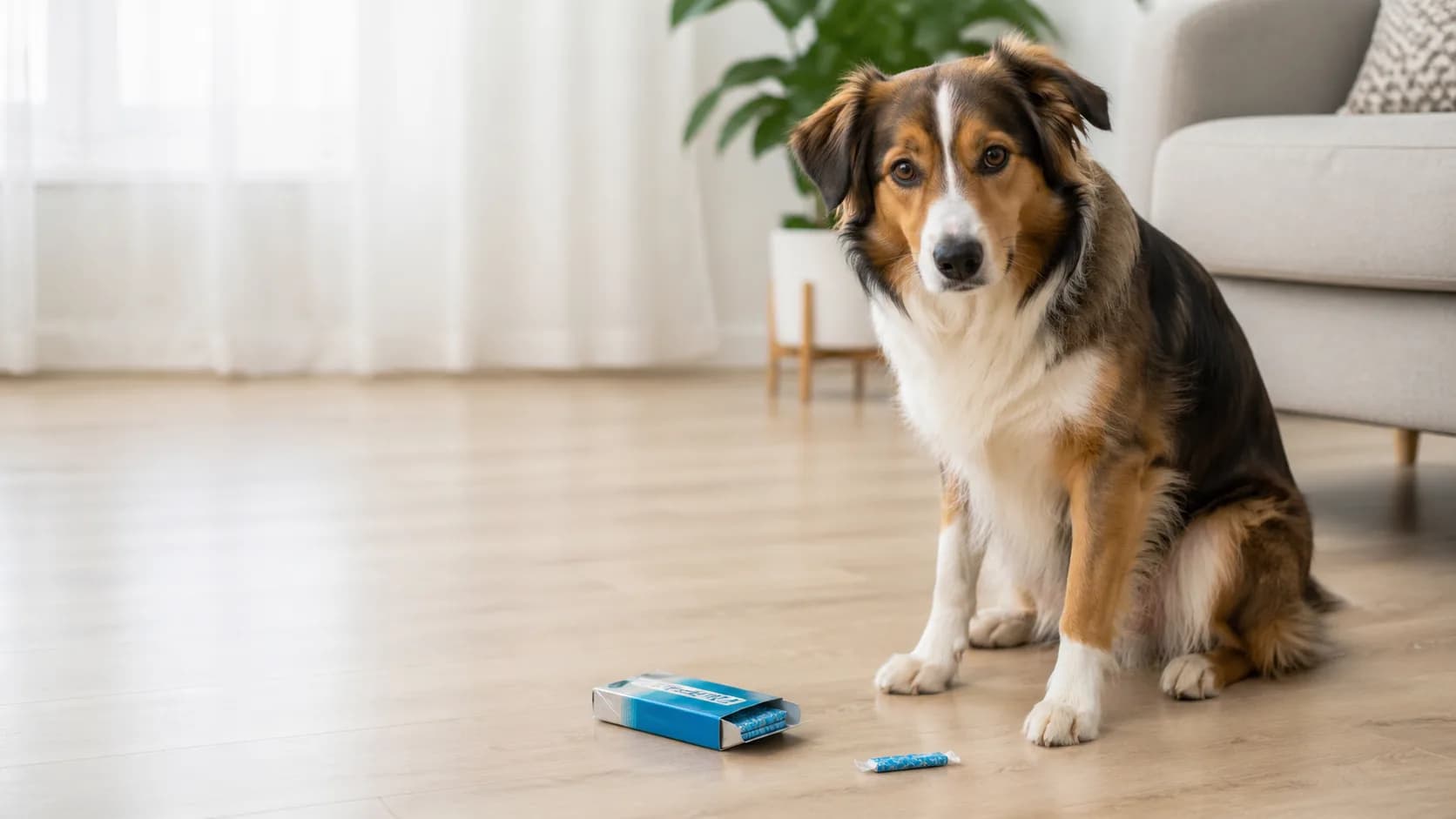
What should you do right now?
Find the gum packaging and read the ingredient list. That single step determines everything that follows.
If the gum contains xylitol, is labeled sugar-free, or if the ingredients are unknown — call a vet, emergency animal clinic, or the Pet Poison Helpline immediately. Do not wait for symptoms. Xylitol poisoning in dogs can progress quickly, and the window for effective intervention is short.
While making that call, have this information ready:
- The brand and flavor of gum
- Whether the packaging lists xylitol or any sugar alcohol in the ingredients
- How many pieces were eaten — or an estimate
- When it happened
- The dog's current weight and condition
Why gum can be dangerous for dogs
Most chewing gum is not dangerous because it contains gum base. It is dangerous because of what sweetens it.
Xylitol — a sugar alcohol used widely in sugar-free products — is highly toxic to dogs. In humans, xylitol does not trigger an insulin response. In dogs, it causes a rapid and significant release of insulin, driving blood sugar to dangerously low levels. Severe cases can also cause liver injury, which may not be apparent until days after ingestion.
The gum base itself can also cause problems if swallowed in quantity — primarily digestive obstruction — but the xylitol risk is the urgent concern.
Does the gum contain xylitol?
Check the label. Look for xylitol listed in the ingredients — it is often the first or second sweetener named in sugar-free products.
Other sugar alcohols, such as sorbitol, maltitol, erythritol, and isomalt, may also appear on labels, but they are not the same as xylitol. Xylitol is the one associated with the severe insulin response and potential liver damage in dogs. If the packaging is unavailable, search the product by brand name online to find the ingredient list, or call the manufacturer's number on the wrapper.
If xylitol is listed — or if confirmation is not possible — treat it as xylitol-containing and call a vet.
How much xylitol is dangerous for dogs?
Very little. Veterinary poison references often cite about 0.1 grams per kilogram as a hypoglycemia risk threshold, with higher exposures linked to liver injury.
Xylitol content varies significantly between gum brands. Some contain 0.2 to 0.3 grams per piece. Others — particularly those marketed specifically for dental health — contain significantly more. A small dog that eats two or three pieces of a high-xylitol gum can ingest a dangerous amount quickly. Do not attempt to calculate safety at home based on piece count alone. Contact a vet or poison control professional who can assess the specific product.
What if your dog ate sugar-free gum?
Treat it as a xylitol exposure until confirmed otherwise. Call a vet or the Pet Poison Helpline immediately.
Many sugar-free gums contain xylitol. There are a small number of xylitol-free sugar-free gums sweetened with other compounds, but without the specific product's ingredient list in hand, that cannot be assumed. The default position for any sugar-free gum exposure is: call first, confirm ingredients while on the call.
What if your dog ate regular gum?
Regular gum sweetened with sugar rather than xylitol does not carry the same acute toxicity risk. The more likely concerns are digestive upset from swallowing the gum base, and in cases where a large amount was swallowed, potential obstruction.
Monitor for vomiting, appetite changes, abdominal discomfort, or difficulty passing stool. A piece or two of regular sugar-sweetened gum in a healthy adult dog is unlikely to cause serious harm, but call a vet if the amount was large, the dog is small, or any symptoms develop. When there is any uncertainty about whether the gum was sugar-free or what the ingredients were, call before deciding to monitor.
Symptoms of xylitol poisoning in dogs
The first signs of xylitol toxicity are typically those of hypoglycemia — low blood sugar. They can appear within 30 minutes of ingestion, though onset sometimes takes longer.
Watch for:
- Vomiting
- Weakness or sudden lethargy
- Loss of coordination or stumbling
- Tremors or muscle twitching
- Collapse or inability to stand
- Seizures
Liver-related symptoms — jaundice, abdominal swelling, prolonged bleeding — may not appear for 24 to 72 hours after ingestion and represent a more serious progression. A dog displaying any neurological signs — stumbling, tremoring, seizuring — needs emergency care immediately.
How long after eating gum can symptoms appear?
Hypoglycemia from xylitol can develop within 30 minutes. In some cases it takes up to 12 hours. Liver toxicity, when it occurs, typically manifests 24 to 72 hours after ingestion.
A dog that seems completely normal an hour after eating xylitol gum has not been confirmed safe — the blood sugar drop may still be coming. This is not a situation where looking fine in the first hour is meaningful reassurance. Waiting for symptoms to appear before calling a vet is exactly the wrong approach with xylitol.
Should you make your dog throw up?
Do not induce vomiting without direct instruction from a vet or poison-control professional.
Whether vomiting is appropriate depends on what was eaten, how much, when it happened, and the dog's current neurological status. Inducing vomiting in a dog that is already showing signs of low blood sugar — weakness, tremors, loss of coordination — can make the situation worse. This decision belongs to a professional with the full clinical picture. Call first.
How vets treat dogs that ate gum
If the ingestion was recent and the dog is not yet symptomatic, a vet may induce vomiting if appropriate, check blood glucose, and begin supportive treatment quickly. From there, treatment centers on stabilizing blood sugar with intravenous dextrose and monitoring liver values through blood work.
Dogs with significant xylitol exposure are typically hospitalized for monitoring — blood glucose levels can fluctuate for hours, and liver values need to be tracked over 48 to 72 hours to catch delayed hepatotoxicity. Dogs that develop liver failure have a significantly worse prognosis than those treated before that progression occurs. Speed of intervention matters considerably in these cases.
What if your dog seems fine?
Still call a vet or poison control. Seeming fine after xylitol ingestion is not reassurance — it is a window.
Blood sugar can drop rapidly and without warning after xylitol exposure. Liver damage can develop silently over the following days. A dog that is alert, moving normally, and behaving typically one hour after eating xylitol gum can deteriorate within the next hour. Do not let a normal-seeming dog delay the call.
What other products contain xylitol?
Gum is the most common source of xylitol exposure in dogs, but it appears in a wide range of other products:
- Toothpaste and mouthwash: Many human oral care products contain high concentrations of xylitol — never use human toothpaste on dogs
- Peanut butter: Some brands use xylitol as a sweetener — check the label before using peanut butter as a dog treat
- Medications and supplements: Some chewable vitamins, melatonin gummies, and over-the-counter medications use xylitol
- Baked goods and desserts: Products marketed as sugar-free or diabetic-friendly may contain xylitol
- Breath mints and candy: Sugar-free versions commonly use xylitol
- Nasal sprays: Some formulations contain small amounts
Reading ingredient labels on anything sugar-free before it enters a household with dogs is a worthwhile habit.
How to prevent gum exposure
Most gum ingestions are preventable. Gum gets left in bags, on counters, in car cup holders, in coat pockets — places that seem out of reach until they are not.
- Store gum in closed bags or containers, not loose in purses or backpacks a dog can access
- Keep car gum and mints in the glove compartment, not in accessible cup holders
- Inform household members and regular visitors that sugar-free gum can be toxic to dogs — many people do not know
- Check peanut butter and supplement labels for xylitol before giving them to a dog
- Never use human toothpaste on dogs
Bottom line
If the gum contained xylitol, was sugar-free, or the ingredients are unknown — call a vet, emergency clinic, or the Pet Poison Helpline immediately. Do not induce vomiting without professional guidance. Do not use a dog that seems fine right now as a reason to delay making that call. Xylitol toxicity moves fast, and the dogs that do best are the ones whose owners acted before symptoms appeared.