

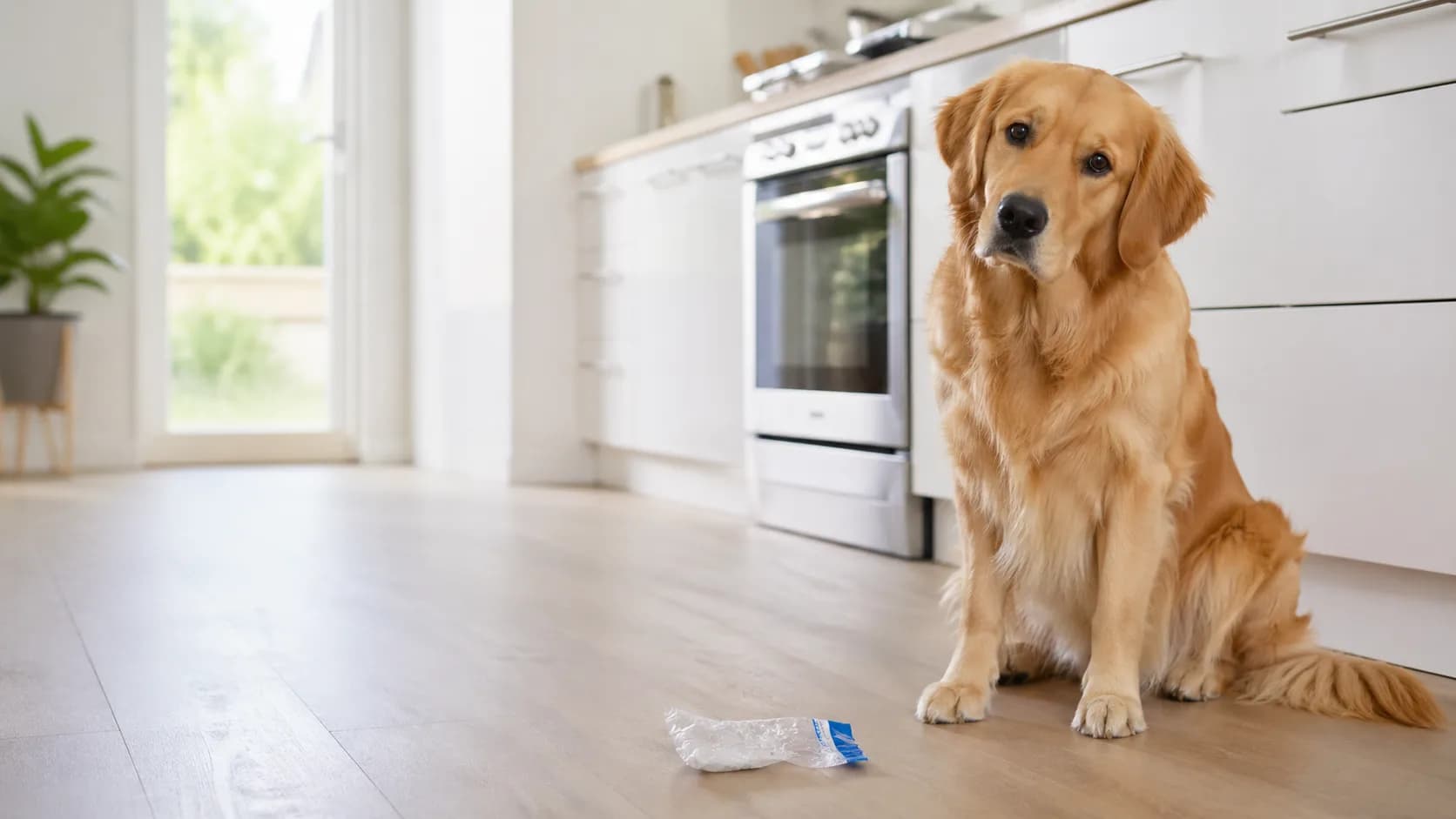
What to do right now
Take away anything the dog can still reach. Then figure out exactly what was swallowed.
A tiny corner of soft packaging is not the same situation as a bottle cap, a broken toy piece, a long plastic strip, or a bag. The material, shape, and size all change the risk profile — which is why "my dog ate plastic" covers an enormous range of actual scenarios, from genuinely low-risk to surgical emergency.
Work through this quickly:
- Remove any remaining plastic from reach
- Identify what type it was — bag, wrapper, toy, bottle cap, straw, container, or unknown
- Estimate the size and amount
- Look for sharp edges, hard fragments, long strips, or missing toy parts
- Watch for vomiting, gagging, drooling, belly pain, bloating, appetite loss, weakness, or difficulty passing stool
- Call a vet if the plastic was large, sharp, hard, or unknown — or if any symptoms are present
When there is genuine uncertainty about what was swallowed, call. Guessing wrong with foreign objects can turn a small problem into a serious one.
What type of plastic was it?
This question matters more than most owners realize.
Soft plastic may pass through without incident in a larger dog. Hard, sharp, jagged, or long plastic is a different matter entirely — it can lodge, cut, obstruct, or perforate tissue at any point from the esophagus to the colon.
- Plastic bag or large wrapper: Can bunch, fold, and create an obstruction even without sharp edges
- Hard plastic fragments: Bottle caps, container pieces, broken plastic — irregular shapes that resist passage
- Sharp or jagged edges: Capable of causing injury to the mouth, throat, stomach lining, or intestinal wall
- Toy pieces: Risk depends entirely on size and whether additional pieces are unaccounted for
- Long strips or stringy plastic: Behaves more like a linear foreign body — a category that carries elevated risk
- Plastic with food residue: Dogs often swallow more than intended because the smell overrides any caution
Sharp, hard, large, or toy-derived plastic should not wait for symptoms before a vet call is made.
Can dogs pass plastic?
Sometimes. Not reliably, and never guaranteed.
A small, soft, rounded piece in a large dog that is acting completely normal has a reasonable chance of passing in the stool. Plastic is not digestible, though, and the digestive tract does not discriminate between something that will pass and something that will not — not until the object has already become a problem.
Blockage symptoms can take hours or days to develop. A dog that seems fine immediately after swallowing something is not confirmed to be fine. The absence of immediate symptoms is not clearance.
Symptoms to watch for
Some dogs deteriorate quickly. Others appear normal for 24 to 48 hours before symptoms emerge.
Watch for:
- Vomiting or repeated unproductive retching
- Gagging or choking
- Excessive drooling
- Refusal to eat
- Lethargy or notable weakness
- Abdominal pain, whining, or hunched posture
- Bloating or visible abdominal distension
- Diarrhea or straining without producing stool
- Complete absence of stool
- Restlessness or obvious discomfort
Vomiting, pain, bloating, weakness, or repeated gagging are urgent. Do not monitor through those symptoms.
When is it an emergency?
When the plastic is the kind that blocks, cuts, or cannot pass.
Call a vet or emergency clinic immediately if the dog ate:
- Anything sharp or jagged
- A large piece of any plastic
- A plastic bag, cling wrap, or long strip
- A bottle cap, broken toy, straw, or container fragment
- Multiple pieces
- Plastic contaminated with food, grease, medication, cleaning products, or chemicals
Also call immediately for vomiting, gagging, bloating, pain, weakness, food refusal, or abnormal behavior — regardless of what type of plastic was involved.
Should vomiting be induced?
No. Not without a vet's explicit instruction.
The instinct to get the plastic out quickly is understandable, but inducing vomiting with a foreign object carries real risk. A sharp or jagged piece that went down without cutting can cause serious injury coming back up. Size and shape change the calculation entirely, and that calculation belongs to the vet — not a home remedy.
The dog ate plastic but seems fine
Seeming fine is not the same as being fine.
For a tiny, soft, rounded piece in a healthy adult dog, a vet may reasonably advise home monitoring. For anything hard, sharp, large, bag-like, stringy, or unknown, calling before symptoms appear is the right move. Objects that are still in the stomach are often manageable in ways that objects deeper in the intestines are not. Early contact with a vet preserves options.
During any monitoring period, track appetite, energy, stool production, belly comfort, and behavior. Any change is a reason to call.
How long before plastic passes?
If a small piece is going to pass, it often shows up in stool within one to two days. Often — not always.
Do not build a plan around a timeline. Some objects move through the entire GI tract without incident. Others sit in the stomach for days. Others lodge in the small intestine and cause a partial or complete obstruction. A dog that is still asymptomatic after 12 hours is not confirmed safe — they are just still asymptomatic.
Vomiting, appetite loss, belly pain, bloating, weakness, or stool changes at any point after plastic ingestion warrant an immediate call.
How vets approach it
The workup depends on what was eaten, when, and how the dog is presenting.
A vet may recommend monitoring, a physical exam, X-rays, ultrasound, endoscopy, or surgery depending on what the assessment reveals. Objects visible in the stomach on imaging may be retrievable endoscopically without surgery, which is why timing matters. The sooner the call is made, the more options are usually on the table.
Preventing it from happening again
Dogs eat plastic because it smells like food, resembles a chew toy, or is simply available.
- Keep bins covered or inaccessible
- Dispose of food wrappers immediately rather than leaving them within reach
- Keep bags, packaging, and containers off accessible surfaces
- Inspect toys regularly and pull anything that has started breaking apart
- Provide appropriate chew alternatives sized for the dog's chewing strength
- Supervise dogs with a known tendency to swallow non-food items
Dogs that repeatedly ingest plastic, fabric, rocks, or other foreign material warrant a veterinary conversation. Compulsive foreign-object eating can reflect behavioral issues, nutritional deficiencies, gastrointestinal disease, or anxiety — and it may not improve without addressing whatever is driving it.
Bottom line
Identify what was eaten and call a vet if there is any uncertainty about the risk. Small and soft may pass. Sharp, hard, large, bag-like, or stringy plastic should not wait for symptoms. Vomiting, pain, bloating, or weakness after any plastic ingestion is urgent. Do not induce vomiting without veterinary instruction — with foreign objects, the next step matters.