

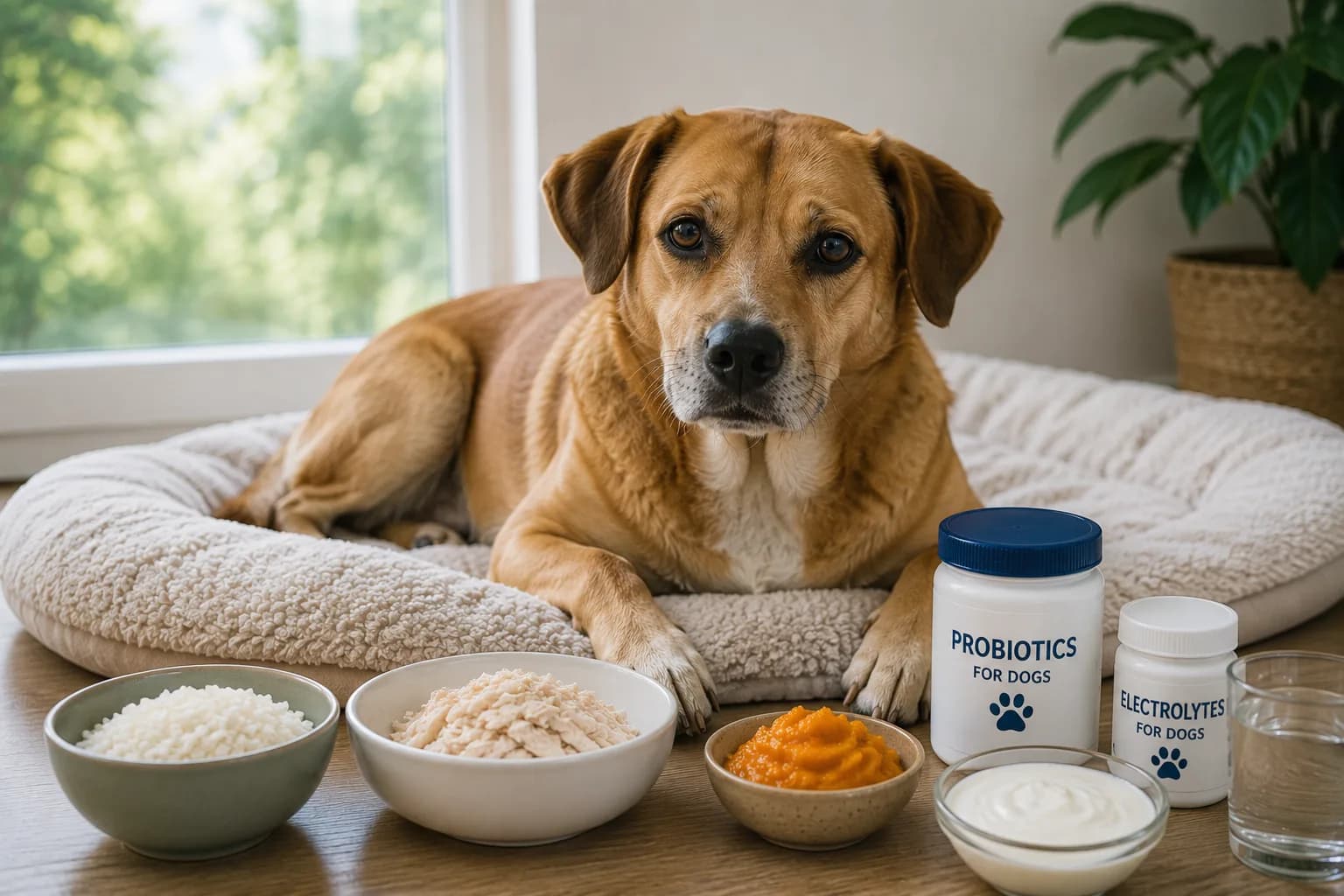
Best Home Remedies for Dog Diarrhea
Most mild cases don't need medicine. They need hydration, a break from rich food, and something easy on the stomach.
The short list for adult dogs with mild upset:
- Fresh water. Dogs dehydrate fast, and small dogs and puppies faster still.
- Small bland meals. Plain boiled chicken and white rice is the classic. So is a vet-approved bland diet.
- Plain canned pumpkin. Not pie filling. Small amounts.
- Vet-approved probiotics. Especially if your vet has already recommended one.
- A call to your vet. When something feels off, make it.
For natural home remedies for dog diarrhea, keep it simple: water, small bland meals, plain canned pumpkin, and dog-specific probiotics are the safest starting points for mild cases.
Diarrhea has a long list of causes — diet changes, spoiled food, parasites, infections, stress, pancreatitis, toxins, medication reactions, or an underlying medical issue. If you don't know what set it off, it's worth being conservative.
One loose stool in a bouncy adult dog is not the same as watery diarrhea all afternoon. Or diarrhea with vomiting. Or diarrhea in a puppy. The more symptoms stack up, the less this is a home-fix situation.
Home care fits one narrow scenario: a mild case in a dog who is bright, drinking, eating, not vomiting repeatedly, not bleeding, not painful, not weak.
Anything outside that, call your vet.
Water and hydration
Water comes before food. Always.
Keep the bowl full and clean. Call your vet if your dog can't keep water down, refuses to drink, has tacky gums, sunken eyes, low energy, or is producing very watery diarrhea. Dehydration can spiral.
Don't let your dog gulp a huge bowl at once. If they drink fast and bring it right back up, that's a vet question, not a try-again situation.
What about Pedialyte or electrolytes?
Do not give Pedialyte or human electrolyte drinks without checking with your vet first. Some dogs may need fluids or electrolytes, but the right choice depends on the dog's size, symptoms, health history, and how much fluid they are losing.
Bland food for dog diarrhea
Boiled chicken and white rice. A prescription GI diet if you already have one. That's the playbook.
Portions matter. A massive bowl of bland food is still a massive bowl of food, and the stomach you're trying to settle is still inflamed. Start small and see how it goes.
Bland actually means bland. No butter, no oil, no salt, no seasoning, no onion, no garlic, no gravy, no bouillon, no leftovers from your plate.
If your dog has food allergies, a pancreatitis history, diabetes, kidney disease, or is on a prescription diet, check with your vet before changing anything.
For ongoing issues, your vet may recommend a prescription GI dog food made for dogs with diarrhea, sensitive stomachs, or chronic digestive problems.
Is rice good for dogs with diarrhea?
White rice is usually the better choice for short-term bland feeding because it is easier to digest than brown rice. Brown rice has more fiber, but that can be harder on an already irritated stomach.
Chicken and rice can help mild diarrhea when both are plain: boiled chicken breast, white rice, no skin, no oil, no salt, no seasoning, no onion, and no garlic. Keep portions small at first.
What foods are good for dogs with diarrhea?
Good foods for mild dog diarrhea are simple, low-fat, and easy to digest. Plain boiled chicken, white rice, small amounts of plain pumpkin, and a vet-approved bland diet are the safest starting points.
Some dogs tolerate plain sweet potato, egg, yogurt, or cottage cheese, but those are not automatic fixes. Dairy can make diarrhea worse in some dogs, and richer foods can trigger more stomach upset. Start with the basics first.
Plain pumpkin for dog diarrhea
Plain canned pumpkin can help mild cases. The fiber is the active ingredient. Plain means plain — not pie filling.
Start small. A tablespoon for most dogs, less for small breeds. Too much pumpkin in a stomach that's already off creates the opposite problem you came for.
Read the label. Anything with sugar, spice, xylitol, or nutmeg is off-limits.
Probiotics for dog diarrhea
A dog-specific probiotic can help after a diet change or mild upset. Buy one made for dogs. Human supplements vary in quality and dosing, and the differences matter.
Probiotics aren't a rescue medication. If the diarrhea is severe, bloody, or paired with vomiting, a probiotic isn't the right tool — that's a vet visit.
What about gas and diarrhea?
Gas plus mild diarrhea usually traces back to something your dog ate that they shouldn't have. A rich treat. Table scraps. A diet switch with no transition.
Water, small bland meals, and watching to see how things go — if your dog is otherwise normal.
Gas with a tense or painful belly is a different conversation. So is bloating, restlessness, weakness, or unproductive retching. Those are emergency-room signs, and they shouldn't wait.
What medicine can you give a dog for diarrhea?
Don't give human diarrhea medicine unless your vet specifically directs you to.
That covers Pepto, Imodium, antibiotics from the back of the cabinet, leftover prescriptions from a previous pet, anti-nausea medication, pain medication, anything labeled for people. The wrong drug can mask symptoms, interact with other meds, worsen an underlying condition, or simply be unsafe for certain dogs.
Dog diarrhea treatment depends on the cause. A dog with parasites needs a dewormer. A dog with pancreatitis needs supportive care. A dog who got into something toxic needs the ER. None of those need a tablet from a forum thread.
Over-the-counter diarrhea medicine for dogs
Over-the-counter diarrhea medicine for dogs should still go through your vet first. The label may say anti-diarrhea, but that does not mean it is safe for your dog, your dog's size, your dog's breed, or the reason the diarrhea is happening.
Some OTC products can hide symptoms your vet needs to know about. Others can cause problems if your dog is dehydrated, vomiting, taking other medication, pregnant, elderly, very young, or has liver, kidney, heart, or digestive disease.
Can you give a dog Pepto for diarrhea?
Only if your vet tells you to, and only at the dose your vet gives you.
Pepto is a human product. It can darken stool, which makes it harder to tell whether blood is in there — and that's information you may need.
If your dog has bloody diarrhea, black stool, is vomiting, is pregnant or nursing, is diabetic, has liver or kidney disease, is on any other medication, or is a puppy, Pepto is off the table without a vet.
Can dogs take Imodium or Kaopectate?
Do not give Imodium, Kaopectate, or similar anti-diarrhea products unless your vet specifically approves them for your dog. These medicines are not safe for every dog, and the wrong situation can make them risky.
Imodium can be especially concerning for some breeds, dogs with certain medical conditions, dogs taking other medications, or dogs whose diarrhea is caused by infection, toxins, or obstruction. If you are considering Imodium or Kaopectate, call your vet first.
When vets prescribe diarrhea medicine
A vet might recommend probiotics, a dewormer, an anti-diarrheal, anti-nausea medication, IV or subcutaneous fluids, a prescription GI diet, or stool testing.
The difference is the exam. Real treatment is based on the dog in front of the vet — the symptoms, the history, sometimes the lab results. That's not something a search bar can replicate.
What can you give a dog for diarrhea and vomiting?
Diarrhea with vomiting is a different category. Bigger problem, less room to wait.
One vomit in a dog who is still bright and drinking might be nothing. Repeated vomiting, vomiting plus diarrhea, refusal to drink, weakness, blood, belly pain, or any sign of dehydration is a vet call.
Don't feed a vomiting dog. No bland food, no pumpkin, no probiotics, no medicine. If the stomach can't hold water, adding anything else makes it worse.
Small dogs, puppies, seniors, and dogs with existing health problems dehydrate faster. For them, vomiting plus diarrhea is taken seriously from the start, not after you've watched it for a day.
What can you give a dog for bloody, bad, or severe diarrhea?
None of the home options. Call your vet or an emergency clinic.
Get on the phone if you see:
- Blood in the stool
- Black or tarry stool
- Repeated watery diarrhea
- Diarrhea with vomiting
- Weakness, collapse, or extreme tiredness
- Belly pain, bloating, or restlessness
- Refusal to eat or drink
- Pale, tacky, or dry gums
- Diarrhea after eating something toxic or unknown
Some serious conditions look like "just diarrhea" in the first few hours — hemorrhagic gastroenteritis, parvo in unvaccinated dogs, pancreatitis, toxin exposure. If the stool looks like raspberry jam or black tar, or your dog seems weak or painful, pumpkin isn't the answer.
What can you give a small dog for diarrhea?
Small dogs have less margin. Less body water, less weight, less time before dehydration becomes dangerous.
For a small adult dog with mild diarrhea and normal energy, the basics are the same — water and very small bland meals. If you use pumpkin, use a teaspoon, not a tablespoon. What's safe for a Lab is not the right dose for a Chihuahua.
Call sooner. Repeated diarrhea, vomiting, blood, weakness, or poor appetite are all earlier triggers in a small dog than a big one.
Large dogs play by similar rules. More body mass buys a little more food tolerance and not much else. Blood, vomiting, dehydration, or symptoms that won't quit still need a vet.
What can you give a pregnant, nursing, or diabetic dog for diarrhea?
These dogs aren't candidates for experimenting.
Pregnant, nursing, lactating, diabetic, very young, very old, or medically fragile dogs have no margin for error. Diarrhea hits their hydration, blood sugar, appetite, and stability faster than it would in a healthy adult.
A pregnant or nursing dog with diarrhea — call before giving anything. Not pumpkin, not probiotics, not a diet change.
A diabetic dog with diarrhea — call. Skipped meals and fluid loss can throw off blood sugar fast, and what looks manageable in the morning can be an emergency by night.
When in doubt with any high-risk dog, lean toward early veterinary input. The downside of an unnecessary phone call is nothing. The downside of waiting too long can be everything.